

One column is missing from Italy's provincial accounts
Government Act 449, province by province, with the numbers for and against.
· Studio Tribuzio
When the Movimento Equità Territoriale, an Italian movement campaigning on regional equality, called Government Act 449 a plan to split Italy, I went and read it and redid the sums from its tables, because economic history teaches that a euro moved sooner or later reaches families.
A clarification first, since other things are being said online. The act concerns 86 provinces and metropolitan cities in Italy's ordinary-statute regions, so offices, roads and upper secondary schools. Hospitals are not involved, and neither are Sicily and Sardinia. On 28 October it received a favourable opinion from the parliamentary committee on fiscal federalism. The decree has not been adopted yet, although the 2026 allocation already uses these numbers.
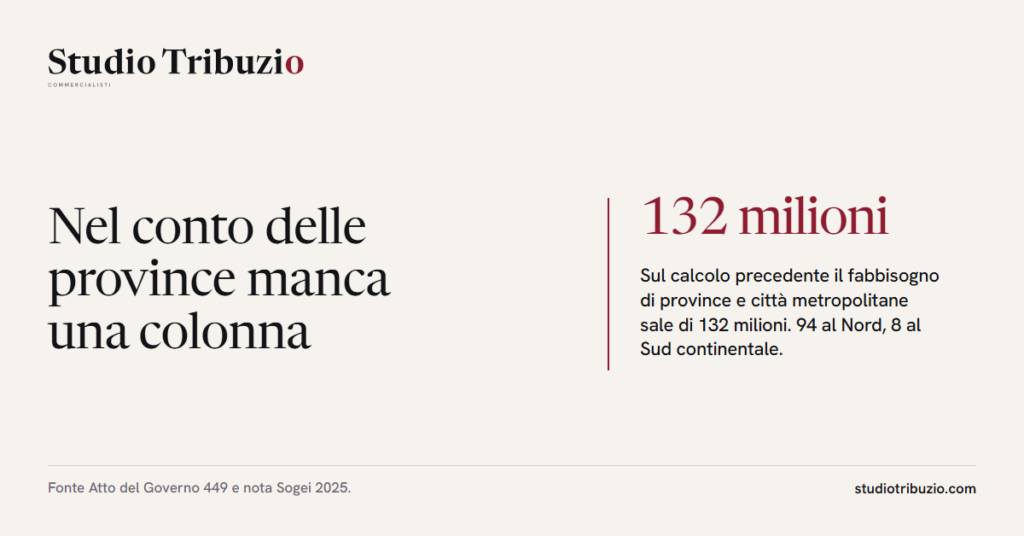
Against the previous calculation, standard needs rise by 132 million euros. Of these, 94 million go to the North, 29 to the Centre and 8 to the mainland South, whose share falls from 28.64% to 27.66%. Bari falls, and so does Foggia, where I was born. L'Aquila, Potenza and Teramo rise.
Put like that, the post seems to have a point. Not entirely. Per head the South is still above the North, 61.46 euros against 59.12, with the gap more than halved and Campania and Puglia already below. Almost half the fall in share is Caserta alone, where schools go from 25 to 14 million, and whether that is the method or a questionnaire I do not know. In cash, on my estimate, standard needs alone are worth about 6 million euros less to the South in 2026, under 50 cents a head, and about 16 million in 2031. Resurfacing done by a province does not move its own figure. And in this allocation 78 bodies out of 86 pay the State more than they receive, the North included.
I stopped on something else, and I will put it as I would to a child. A family works out what it costs to keep up the children's bedrooms. If a child leaves, the bill drops. If a child sleeps in the living room it records a minimum, and the missing bedroom is not written down.
The technical note by Sogei reasons that way, apart from minor items, about 7% of the total. No variable asks what state a road is in or which school is missing. The words divario (gap) and livelli essenziali (essential levels) do not appear. For works in the South there is a separate fund, granted, but it is another sheet.
And the young. From 2019 to 2024 those aged 14 to 18 fell by 5.2% in the South and rose by 5.1% in the North. How much that weighs on the fall I cannot separate, one school year lies between the two calculations, and even counting five, on my estimate, it comes to between a third and a half of the fall. Italy's statistics office counts about 150,000 young graduates lost by the South between 2019 and 2025, and research on Europe finds that the longer stagnation lasts, the stronger the vote against the Union (Rodríguez-Pose and others, 2024). I have not measured a link with this act, and I say so before someone else does.
Australia shares out its resources so that each State can provide services and infrastructure to the same standard, with the same effort and efficiency. I have already written that money alone is not enough.
If we want this family to grow, the measures have to say the same thing as the thinking. I would settle for the questionnaire data body by body, Caserta included, and beside the bill a column with what is missing. I am not asking for one euro more, and the Centre-North, whose firms have their main outlet market in the South, has as much reason to know as we do. On Wednesday 4 November at 8.30 the committee's bureau returns to the act. If the measures then hold up they are accepted, whoever proposes them.
Arduino Tribuzio, chartered accountant in Bari
Anyone can look up a province in Il conto delle province, our simulator, in Italian, with all 86 bodies.
Sources
- Government Act 449 (Atto del Governo 449), text sent to Parliament on 14/10/2026, Sogei note of 11/11/2025, tables D.1 and E.1, documenti.camera.it/apps/nuovosito/attigoverno/Schedalavori/getTesto.ashx?file=0449.pdf&leg=XIX
- Parliamentary committee on fiscal federalism, bulletin of 28/10/2026, pp. 229-234
- Sogei, update of standard needs for 2025, 25/10/2024, tables A.1 and B.1, mef.gov.it
- Interior and Finance ministries decree of 19/02/2026, annex A and annexes 1 and 2, dait.interno.gov.it/documenti/decreto-fl-19-02-2026-all-a-nota-metodologica.pdf
- Law 42/2009, art. 22, c. 1-ter, infrastructure equalisation fund for the South, normattiva.it
- Istat, resident population at 1 January 2019 and 2024, demo.istat.it, and internal and international migration 2024-2025, istat.it
- A. Rodríguez-Pose, L. Dijkstra, H. Poelman, The Geography of EU Discontent and the Regional Development Trap, Economic Geography, 2024
- Productivity Commission (Australia), Horizontal Fiscal Equalisation, 2018, PDF p. 21, assets.pc.gov.au/inquiries/completed/horizontal-fiscal-equalisation/report/horizontal-fiscal-equalisation.pdf
- F. Panetta, Eppur si muove. L'economia del Mezzogiorno dopo la crisi, Banca d'Italia, 19/09/2024, p. 1, note 1
- Calculations by body and cash estimates are ours, from the tables and the formula cited. The South here is six mainland regions.